RSS

Tag Archives: Family

25 Years Later: Remembering September 11, 2001

25 Years Later: Remembering September 11, 2001

25 Years Later: Remembering September 11, 2001

September 11, 2026

Twenty-five years ago, on the morning of September 11, 2001, I woke up around 7:00 or 7:30 to prepare breakfast for a house full of family before heading to work.

We were in Bedford, Texas, and my dad (Tevita Vaiola Finau) was nearing the end of his life. Family had come from near and far to spend time with him. His younger brother, Haitini, had come from Tonga and had already been with us for a while. His sister, Ngalo‘afe, and her son Sam Taufa had been there for perhaps a week or two. My brother Lipoi had come from Boston, and my cousin Tevita Havea was visiting before returning to the UK, where he was attending school.

I was grateful to have my aunt there, and of course, there was Sam, always annoying and funny at the same time. He had that Tongan kind of humor where the joke was often at your expense, and Sam did not always know where the limits were. Even during a difficult season for our family, there was still laughter in the house.

That Tuesday morning, I was in the kitchen trying to make omelets when I heard Lipoi from the second living room on the phone. His son Kofe had called from Boston telling him to turn on the news. A plane had crashed into one of the Twin Towers.

Tevita woke up, and soon everyone else in the house did too. We turned on the television, and before long, the second tower was hit as we watched it live.

There was shock, and an unspoken fear in the house. No one needed to name it. There was hesitation, uneasiness, confusion, and sadness as we watched something unimaginable unfold, unsure of what it meant or what might happen next.

Still, breakfast needed to be finished.

So I kept cooking and trying to turn around every few seconds to watch the screen.

I made breakfast for Dad and everyone else, got ready, and went to the office later that morning. I didn’t have to, but I felt I needed to. My office was also in Bedford, which made it convenient, and it was about 10 minutes from Dallas/Fort Worth International Airport.

But the office was not the same.

There was silence, sadness, and an unprocessed nervousness. Things were on hold. Some of us stepped outside onto the sixth-floor balcony to sit together and process what was happening.

And I remember the sky.

Living and working so close to DFW Airport, we were accustomed to seeing and hearing airplanes all the time. But that day, after flights across the country were grounded, there were none.

No planes overhead.

The silence was eerie.

I eventually went home, and we simply sat, talanoa (talked), watched the news, and wondered what would happen next. My aunt wanted to return home to Sydney sooner. Tevita was supposed to fly back to the UK the next day, but his flight was canceled. Lipoi needed to return to Boston for work, but his flight was canceled too.

Nobody was going anywhere.

So, for a little longer, we were all there together.

That Tuesday evening, we went to church. Tevita preached that night. Afterward, we went to Denny’s, one of the few restaurants we found open.

Looking back twenty-five years later, it is strange what the mind holds onto.

I remember cooking omelets. I remember the television. I remember the silence at work. I remember looking into a sky without airplanes. I remember canceled flights and disrupted plans.

But mostly, I remember my family.

September 11 will forever be remembered for the thousands of lives lost that day and for the countless families whose lives were forever changed. Yet woven into my memory of that terrible day is gratitude. I am grateful that when those horrific events unfolded, I was surrounded by family.

We had gathered because another goodbye was already approaching.

Eventually, the skies reopened. Lipoi returned to Boston. Tevita returned to the UK. My aunt Fē and Sam eventually returned to Sydney. Everyone made it back to wherever home was.

Then, just weeks later, on October 29, 2001, my dad also went home to his final resting home.

And our family gathered again.

Tevita returned from the UK. Jione came from Australia. Ma‘ata and Mele‘ana came from Tonga. Haitini’s sons came too, Niponi from Los Angeles and Kisione from Fiji. Haitini had stayed with us through Dad’s final days. Once again, our family came from across the world, this time to say goodbye.

Twenty-five years later, September 11 reminds me of how suddenly life can change, how quickly our plans can be interrupted, and how precious it is to find ourselves surrounded by the people we love when it happens.

We could not control the planes, the schedules, the uncertainty, or the losses that were coming.

But for that moment, we were together.

And twenty-five years later, that is one of the things I remember most.

Sela Finau


Tags: , , , , , , , ,

Amelia Lolohea Namoa Funeral: Maumau Ceremony

Amelia Lolohea Namoa Funeral: Maumau Ceremony

Amelia Lolohea Namoa Funeral

Maumau Ceremony: A traditional Tongan funeral practice

December 17 – 20, 2025

Kaua’i, Hawai’i 

The sun was beginning to dip lower over Kaua’i, casting long shadows that mirrored the heaviness in our hearts. It was the final day of our gathering, that bittersweet moment when the reality of departure sets in. Soon, the family would scatter—some to other islands, others back to the mainland. For my younger brother, Kaueni, his daughter, Mata, and me, the long route back to Texas loomed ahead. We had spent a couple of days in a cocoon of collective grief, and now, the world was waiting to rush back in.

The journey to this final afternoon had been a sacred marathon. On Friday, we held the wake from 5:00 PM until 11:00 PM—a sea of black attire and meaningful Tongan hymns that narrate our grief and hope. Then came the “midnight snack,” Tongan style. For us, a light late-night bite isn’t a granola bar; it’s a full feast complete with a roast pig! I had to laugh at the scale of it, but that communal meal sustained us for the vigil. Amelia’s body remained in the church all night, her children staying by her side until dawn. Saturday morning brought the final service from 9:00 AM until approximately 1:00 PM. We then proceeded to the Kaua’i Memorial Gardens, returning Amelia’s body to the earth while her soul returned to God.

Earlier in the day, the ‘Ulumotu’a, Lua Lolohea (Amelia’s older brother), told us to return to the church fellowship hall for one last event. I agreed to be there, not fully knowing what would take place, but knowing it was important to show up. When I walked in, the ladies had the Maumau Ceremony ready. I was essentially thrust into the deep end without a choice. This was a sharp contrast to this past February, when my second-oldest brother, Sione, died. At that time, some of my sisters-in-law asked me to cut their children’s hair, but because I didn’t fully understand the depth of the tradition, we didn’t proceed.

In Tongan culture, the word maumau translates to “damage,” “broken,” “destruction,” or “waste.” In the sacred context of a traditional Tongan funeral (putu or me’a faka’eiki), it refers specifically to the ritual of hair cutting. In the past, this ritual takes place after 10 days of mourning after the burial. Today, it takes place after the burial. This act is a profound symbolic gesture of grief, humility, and the sacrifice or “destruction” of one’s own beauty or honor to pay tribute to the deceased. A person’s hair, especially a woman’s hair, is considered one of her most precious attributes and a symbol of her personal honor. By cutting it, they are physically demonstrating that their own status and beauty are secondary to the loss of their loved one.

The word Maumau emphasizes that we are intentionally “spoiling” something valuable about ourselves as an offering of respect and love for the deceased.

The ritual is governed by the social hierarchy that defines Tongan Family life. The maumau is performed by those who are of a lower rank than the deceased. When a father dies, his children, his paternal nieces and nephews, and certain maternal relatives perform the ritual. For a mother or sister, her brother’s children and specific maternal relatives (kau liongi) perform it. Her own children do not perform it, but are participants for their father or their father’s sister. The mother’s side of the family is always considered lower in rank than the father’s side, which is why maternal relatives are consistently included.

Often, the hair is cut by the Fahu, who holds the highest rank in the family. The fahu is usually the father’s eldest sister or her children. In Amelia’s case, the fahu was her first cousin, Sela. Amelia’s father, Tupou, and Sela’s mother, Lile, were siblings. My mother, Lile, was the second-oldest female, but because her oldest sister and her daughter had died, Sela (me) was the next in line. Furthermore, the family specifically asked me to Fahu.

This was my first time participating in this practice, as it was for most of us this day. There was a bit of confusion at the beginning, but one of the moms graciously corrected us. Though we were hesitant at first, the practice and tradition take on profound meaning when we understand them. 

Sometimes funerals happen so quickly that we want everything to go according to our schedule. But death is never convenient, and it always disrupts. There should always be a heaviness with funerals to acknowledge the loss of life and the emptiness that the family will feel.

At the beginning of the ceremony, one of the moms gave a speech. And then, one by one, a niece or nephew approached me wearing their ta’ovala—large, old, or coarse waist mats. During mourning, family members wear large, old, or coarse mats around their waist. The oversized ta’ovala, which typically covers from head to toe, signifies that one is being overcome by grief to attend to one’s appearance. At the same time, the physical discomfort of the mat embodies the inner anguish of loss. The bigger the ta’ovala, the lower in rank you are; the liongis wear the largest ones. As they approached, I cut a portion of their hair as a sign of love, respect, submission, and shared mourning. Traditionally, the cut is shoulder-length, but today, it is just a trim. The physical alteration serves s a reminder of loss and a testament to the mourner’s devotion to the deceased.

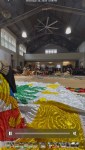
Central to the Maumau Ceremony is the role of the Fahu. Her presence is essential, and her actions carry significant weight. Gifts were given for the Fahu, including Tongan mats, ngatu (tapa cloth), blankets, and money. This act symbolizes her acceptance of their offering of humility, love, and grief.

For those who understand and value our culture and tradition, Maumau is deeply an emotional and humbling experience. It reinforces that death is disruptive and carries an emotional weight, allowing space for grief and communal acknowledgment of loss. We’re glad to carry forward this tradition and practice.

A traditional kava ceremony had also taken place, but that’ll be another post. Present at this Kava Ceremony and funeral procession were two nobles: Lords Vaha’i and Fakatulolo.

Rest in peace, Amelia! Toka ā ‘ihe nonga Moe Fiemalie ‘a e ‘Eiki!

‘Ofa lahi atu, Sela 


Tags: , , , , , , , , , , , , , , , ,