RSS

When God Interrupts Our Routine

When God Interrupts Our Routine

When God Interrupts Our Routine

1.29.26

Over the past few days, life has been interrupted in ways both ordinary and heartbreaking. Icy and dangerous road conditions forced schools to close, businesses to adjust hours or shut their doors, churches, including ours worship online, and families across Texas, and much of the country, to change plans and slow down. What we expected our days to look like suddenly shifted.

But alongside those practical disruptions, deeper interruptions emerged, ones that no amount of planning could have prevented.

Tragedy struck families and communities without warning. Two teenage girls were killed in a sledding accident. Three young children fell into a pond and could not be saved. We grieved the tragic death of Alex Pretti. All around us, a growing sense of unrest and uncertainty fills our nation. There is much angst and unsettledness within us right now, and perhaps rightly so.

In the midst of all this, my own family has also been walking through tragedy. We are still trying to come to terms with a loss that feels unbearable. The pain is deep. Our hearts are broken. Our souls feel shattered in ways words can barely hold. There are dark nights of the soul, questions without answers, and moments when all we can do is breathe and entrust ourselves to God. We ask the same question humanity has asked since the beginning of time and still asks today: Why, God?

Last Sunday’s Gospel reading from Matthew 4 met me, and perhaps many of us, right there.

Jesus begins his ministry not in a moment of calm or clarity, but in a time of disruption. John the Baptist has been arrested. Fear and uncertainty are in the air. Yet Jesus steps forward and proclaims, “The kingdom of heaven has come near.” Walking along the Sea of Galilee, Jesus calls ordinary fishermen in the middle of their work and invites them to follow.

This story reminds us that God does not wait for perfect conditions. God does not wait until grief has resolved or questions have neat answers. God shows up in the middle of real life, when routines are disrupted, when tragedy strikes, and when the world feels fragile and unfinished.

This past week, the world also paused to remember the Holocaust. I was reminded of the words of Elie Wiesel, Nobel Prize laureate, Holocaust survivor, and author of Night, who once said, “The opposite of love is not hate, it is indifference.” In moments like these, when pain surrounds us and grief feels overwhelming, indifference is not an option for people of faith.

When God interrupts our routine, it is not to minimize our pain or silence our questions. It is not to rush us toward easy answers. Rather, God interrupts to reorient us toward compassion instead of indifference, presence instead of withdrawal, and love that dares to stay even when understanding eludes us.

Faith does not remove the ache. It does not erase the “why.” But it does remind us that we do not grieve alone, question alone, or walk through darkness alone.

And so, even in disrupted days and broken-hearted seasons, we continue to listen for God’s call. We continue to follow Jesus, not because the path is clear, but because love still matters, presence still heals, and God is still near.

Grace and peace, sela 


Tags: , , , , , , , , , ,

Beloved Community

Beloved Community

January 23, 2026

Beloved Community

This past Sunday in worship, we reflected on Acts 10 and Peter’s powerful realization: “I truly understand that God shows no partiality.” In this story, Peter is led by God beyond the boundaries he had known all his life and into the home of Cornelius, a Gentile. What changes in this moment is not God, but Peter. His eyes are opened to see that God had already been at work, welcoming and claiming those he once believed were outside. The division is broken, and new life is offered as Cornelius and his entire household are baptized.

This Scripture felt especially timely on a weekend when we remember the life and witness of Dr. Martin Luther King Jr., whose faith shaped his deep belief in beloved community, human dignity, and justice rooted in love. Dr. King understood that faith is never only personal; it carries public responsibility. He marched, organized, and spoke out because silence in the face of injustice was not an option. His witness reminds us that meaningful change has always required courage, sacrifice, and collective action.

On Monday, I had the opportunity, along with many members of our community, to participate in the local Taylor MLK Celebration. The day began with a march and continued with a meaningful program at the library. The space was full, standing room only, and it warmed my heart to see people from all walks of life, races, and nations gathered together. In that moment, we caught a glimpse of what beloved community can look like: neighbors standing side by side, united in hope, remembrance, and shared purpose.

I was also deeply encouraged to see reports and images from Minnesota, where tens of thousands gathered and marched in bitterly cold temperatures reaching well below zero, to stand for justice and human dignity. I was especially moved to see so many courageous clergy colleagues and faith leaders present, serving as witnesses. Their presence reminded me that things do not change if we simply stay home and hope or pray for them to change. Faith is active. Faith shows up.

As people of faith, we are called to care deeply about how others are treated. Every human person, regardless of status, background, or circumstance, deserves to be treated with dignity and humanity. When people are treated in ways that strip them of that dignity, faith requires more than quiet concern. It requires that we speak up, stand together, and refuse to be silent. There are moments when holy anger is not only appropriate but necessary because love demands justice.

Even in a divided world, these moments remind me that God is still at work. The Spirit continues to move among ordinary people who believe that beloved community is possible and who are willing to show up, bear witness, and act in hope for the future.

Grace and peace,

Sela 


Tags: , , , , , , , , ,

In the Beginning…Again

In the Beginning…Again

In the Beginning… Again

1.6.26

The first Sunday of the year is more than a calendar change; it is a threshold moment. On Epiphany Sunday, we were reminded that God’s story is always about new beginnings, even when the path ahead is not fully clear.

John’s Gospel opens not with a manger, but with creation itself: “In the beginning was the Word.” From the very start, God speaks light into darkness, life into uncertainty, and hope into places that feel worn or unfinished. Epiphany reminds us that this light did not stop shining long ago; God continues to reveal Christ in surprising ways, often beyond our expectations and assumptions.

Like the Magi, we are invited to see differently in this new year, to look up, to notice where God is already at work, and to follow the light we’ve been given, even when we don’t yet see the whole journey. This new beginning is not about perfection, but about alignment: refocusing our hearts, recalibrating our priorities, and repurposing our lives for God’s love in the world.

We were reminded that we do not begin again by our own strength. We begin again by grace. At Christ’s table, we receive that grace anew, bread broken, cup shared, love offered freely, so that we might be sent forward as people of light in a world still longing to see.

As this year unfolds, may we trust that God is still revealing, still surprising, and still making a way. And may we have the courage to begin again, in the beginning… again. 


Tags: ,

Amelia Lolohea Namoa Funeral: Maumau Ceremony

Amelia Lolohea Namoa Funeral: Maumau Ceremony

Amelia Lolohea Namoa Funeral

Maumau Ceremony: A traditional Tongan funeral practice

December 17 – 20, 2025

Kaua’i, Hawai’i 

The sun was beginning to dip lower over Kaua’i, casting long shadows that mirrored the heaviness in our hearts. It was the final day of our gathering, that bittersweet moment when the reality of departure sets in. Soon, the family would scatter—some to other islands, others back to the mainland. For my younger brother, Kaueni, his daughter, Mata, and me, the long route back to Texas loomed ahead. We had spent a couple of days in a cocoon of collective grief, and now, the world was waiting to rush back in.

The journey to this final afternoon had been a sacred marathon. On Friday, we held the wake from 5:00 PM until 11:00 PM—a sea of black attire and meaningful Tongan hymns that narrate our grief and hope. Then came the “midnight snack,” Tongan style. For us, a light late-night bite isn’t a granola bar; it’s a full feast complete with a roast pig! I had to laugh at the scale of it, but that communal meal sustained us for the vigil. Amelia’s body remained in the church all night, her children staying by her side until dawn. Saturday morning brought the final service from 9:00 AM until approximately 1:00 PM. We then proceeded to the Kaua’i Memorial Gardens, returning Amelia’s body to the earth while her soul returned to God.

Earlier in the day, the ‘Ulumotu’a, Lua Lolohea (Amelia’s older brother), told us to return to the church fellowship hall for one last event. I agreed to be there, not fully knowing what would take place, but knowing it was important to show up. When I walked in, the ladies had the Maumau Ceremony ready. I was essentially thrust into the deep end without a choice. This was a sharp contrast to this past February, when my second-oldest brother, Sione, died. At that time, some of my sisters-in-law asked me to cut their children’s hair, but because I didn’t fully understand the depth of the tradition, we didn’t proceed.

In Tongan culture, the word maumau translates to “damage,” “broken,” “destruction,” or “waste.” In the sacred context of a traditional Tongan funeral (putu or me’a faka’eiki), it refers specifically to the ritual of hair cutting. In the past, this ritual takes place after 10 days of mourning after the burial. Today, it takes place after the burial. This act is a profound symbolic gesture of grief, humility, and the sacrifice or “destruction” of one’s own beauty or honor to pay tribute to the deceased. A person’s hair, especially a woman’s hair, is considered one of her most precious attributes and a symbol of her personal honor. By cutting it, they are physically demonstrating that their own status and beauty are secondary to the loss of their loved one.

The word Maumau emphasizes that we are intentionally “spoiling” something valuable about ourselves as an offering of respect and love for the deceased.

The ritual is governed by the social hierarchy that defines Tongan Family life. The maumau is performed by those who are of a lower rank than the deceased. When a father dies, his children, his paternal nieces and nephews, and certain maternal relatives perform the ritual. For a mother or sister, her brother’s children and specific maternal relatives (kau liongi) perform it. Her own children do not perform it, but are participants for their father or their father’s sister. The mother’s side of the family is always considered lower in rank than the father’s side, which is why maternal relatives are consistently included.

Often, the hair is cut by the Fahu, who holds the highest rank in the family. The fahu is usually the father’s eldest sister or her children. In Amelia’s case, the fahu was her first cousin, Sela. Amelia’s father, Tupou, and Sela’s mother, Lile, were siblings. My mother, Lile, was the second-oldest female, but because her oldest sister and her daughter had died, Sela (me) was the next in line. Furthermore, the family specifically asked me to Fahu.

This was my first time participating in this practice, as it was for most of us this day. There was a bit of confusion at the beginning, but one of the moms graciously corrected us. Though we were hesitant at first, the practice and tradition take on profound meaning when we understand them. 

Sometimes funerals happen so quickly that we want everything to go according to our schedule. But death is never convenient, and it always disrupts. There should always be a heaviness with funerals to acknowledge the loss of life and the emptiness that the family will feel.

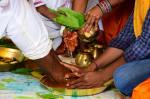
At the beginning of the ceremony, one of the moms gave a speech. And then, one by one, a niece or nephew approached me wearing their ta’ovala—large, old, or coarse waist mats. During mourning, family members wear large, old, or coarse mats around their waist. The oversized ta’ovala, which typically covers from head to toe, signifies that one is being overcome by grief to attend to one’s appearance. At the same time, the physical discomfort of the mat embodies the inner anguish of loss. The bigger the ta’ovala, the lower in rank you are; the liongis wear the largest ones. As they approached, I cut a portion of their hair as a sign of love, respect, submission, and shared mourning. Traditionally, the cut is shoulder-length, but today, it is just a trim. The physical alteration serves s a reminder of loss and a testament to the mourner’s devotion to the deceased.

Central to the Maumau Ceremony is the role of the Fahu. Her presence is essential, and her actions carry significant weight. Gifts were given for the Fahu, including Tongan mats, ngatu (tapa cloth), blankets, and money. This act symbolizes her acceptance of their offering of humility, love, and grief.

For those who understand and value our culture and tradition, Maumau is deeply an emotional and humbling experience. It reinforces that death is disruptive and carries an emotional weight, allowing space for grief and communal acknowledgment of loss. We’re glad to carry forward this tradition and practice.

A traditional kava ceremony had also taken place, but that’ll be another post. Present at this Kava Ceremony and funeral procession were two nobles: Lords Vaha’i and Fakatulolo.

Rest in peace, Amelia! Toka ā ‘ihe nonga Moe Fiemalie ‘a e ‘Eiki!

‘Ofa lahi atu, Sela 


Tags: , , , , , , , , , , , , , , , ,

Love Has Come to Stay

Love Has Come to Stay

Christmas Day – December 25, 2025

John 1:14
Love Has Come to Stay

The Word became flesh and lived among us. Love did not merely visit, it moved in. God chose to dwell fully with humanity, sharing in joy and sorrow, celebration and struggle.

Christmas Day reminds us that God’s love is not limited to one night or one moment. Christ comes to stay. To walk with us through ordinary days and uncertain seasons. To guide us, heal us, and remind us that we are not alone.

Whatever today looks like for you, busy or quiet, joyful or tender, God is present. Love has taken up residence in the world, and nothing will ever be the same.

Today, rest in this gift. Christ is born. Love has come to stay.

Prayer:
God of love, we give thanks for the gift of Christ. Help us live each day rooted in your presence and guided by your love. Amen.

Merry Christmas!


Tags: , , ,

Love Has Come Near

Love Has Come Near

Christmas Eve – December 24, 2025

Luke 2:1–14
Love Has Come Near

On this holy night, love does not arrive with fanfare or force. It comes quietly, in a stable, under the cover of darkness, wrapped in vulnerability. God chooses nearness over power, presence over perfection.

The world Christ enters is not calm or orderly. It is crowded, uncertain, and restless, much like our own. Yet this is exactly where God chooses to dwell. Not waiting for everything to be right, but coming close in the middle of it all.

Tonight, we remember that love does not stand at a distance. It steps into our lives as they are. It meets us in our fears, hopes, longings, and needs. The angels’ song announces peace, not because the world is suddenly fixed, but because God is with us.

As candles are lit and voices rise in song, receive this truth: Christ is born for you. Love has come near.

Prayer:
God with us, thank you for coming close. Fill our hearts with wonder, peace, and gratitude as we welcome the birth of Christ. Amen. 

Merry Christmas! 


Tags: , , ,

Love That Chooses the Hard Way

Love That Chooses the Hard Way

Tuesday, December 23, 2025

Matthew 1:18–21
Love That Chooses the Hard Way

Joseph doesn’t say much in the Christmas story, but his actions speak loudly. When he learns Mary is pregnant, his world shifts in an instant. Scripture tells us Joseph is a righteous man, and his first instinct is to do what is right and to do it kindly. He plans to dismiss Mary quietly, sparing her shame.

Many of us know what it feels like to stand at a crossroads like that. To be hurt, confused, or afraid, and still try to respond with integrity. To do the loving thing when it would be easier to walk away. Joseph’s love shows up not in grand words but in careful decisions and quiet courage.

Then God intervenes. In a dream, Joseph is invited to trust a bigger story than the one he can see. He does. He stays. He protects. He steps into a future he did not plan but chooses love anyway.

Advent reminds us that love is not always easy or clear. Sometimes love is choosing faith over fear, compassion over control, and trust over certainty. Joseph shows us love often begins with doing the next right thing, even when the path ahead is uncertain.

Prayer:
God of faithfulness, give us courage to choose love when the way forward is hard. Help us trust you when the story unfolds differently than we imagined. Amen.


Tags: , , ,

Love That Came Anyway

Love That Came Anyway

Monday, December 22, 2025

1 John 4:9–10
Love That Came Anyway

As the year draws to a close, many of us look back. We remember moments of faithfulness and moments we wish we could redo. There were days we showed up fully and days we fell short. Some choices were life-giving; others shaped by fear, exhaustion, or uncertainty.

Scripture reminds us that God knows all of this—and still chose to send Jesus into the world.

God did not wait for humanity to get it right. God did not wait for us to be faithful, generous, or strong enough. Out of love, Christ was sent to help, heal, guide, and save us, right in the middle of our unfinished stories.

Advent invites us to hold our whole year before God: the good and the hard, the faithful and the messy. Love does not arrive as a reward. It comes as a gift. Jesus enters the world not because we are worthy but because God is loving.

As Christmas draws closer, receive this truth again: whatever this year has held for you, God has not given up. Love has come anyway.

Prayer:
God of mercy and love, receive all that this year has been. Thank you for sending Christ to meet us in our need, to guide us toward healing and hope. Amen.


Tags: , , , , , ,

Love That Comes to Us

Love That Comes to Us

Fourth Sunday of Advent – December 21, 2025

Luke 1:39–45
Love That Comes to Us

Have you ever had an unexpected guest, someone you admired deeply, whose presence felt like a gift? Maybe you wondered, What did I do to deserve this? The house wasn’t ready, life wasn’t perfectly in order, but the moment still felt surprising and holy.

That must be how Elizabeth felt when Mary arrived at her door. This was no ordinary visit. Mary brought both uncertainty and promise, and Elizabeth, who knew what it was to wait, was suddenly filled with joy. Scripture tells us that the child in her womb leapt, and Elizabeth was filled with wonder. “Why has this happened to me,” she asks, “that the mother of my Lord comes to me?” Her question is not doubt, but awe.

Elizabeth sees grace when it appears. She does nothing to earn it. She simply receives it.

That is how God’s love works. Grace comes to us, often unexpectedly and rarely when we expect it. Advent reminds us that Christ does not wait for us to be ready or deserving. Christ comes to us. Love draws near. And something inside us stirs with joy.

Today, think about where grace might be surprising you. God may already be closer than you realize.

Prayer:
God of love and grace, open our hearts to receive your presence with gratitude and joy as we prepare for Christ’s coming. Amen.


Tags: , , , ,

Joy on the Edge of Arrival

Joy on the Edge of Arrival

Saturday, December 20, 2025

Luke 1:46–49
Joy on the Edge of Arrival

Mary sings her song before the child is born. Her joy comes not from having all the answers, but from trusting what God has started. She rejoices, not because the path is simple, but because God keeps promises.

There is a particular kind of joy that comes when we are close, close to a long-awaited moment, close to an answered prayer, close to something new taking shape. Advent holds us in that space. We are not yet at Christmas, but we can feel it approaching. Joy gathers there, at the edge of arrival.

This joy is often quiet and steady. It shows up in final preparations, in small acts of care, in the ordinary faithfulness of showing up one more time. It reminds us that God does not wait for perfect conditions to draw near.

As this Advent week comes to an end, pause for a moment. Take a breath. Notice the joy that is already here, even before everything is finished. God is closer than we think.

Prayer:
God of promise, steady our hearts as we wait. Help us rejoice in what you are already bringing to life among us. Amen.


Tags: , , , , ,