Amelia Lolohea Namoa Funeral
Maumau Ceremony: A traditional Tongan funeral practice
December 17 – 20, 2025
Kaua’i, Hawai’i
The sun was beginning to dip lower over Kaua’i, casting long shadows that mirrored the heaviness in our hearts. It was the final day of our gathering, that bittersweet moment when the reality of departure sets in. Soon, the family would scatter—some to other islands, others back to the mainland. For my younger brother, Kaueni, his daughter, Mata, and me, the long route back to Texas loomed ahead. We had spent a couple of days in a cocoon of collective grief, and now, the world was waiting to rush back in.
The journey to this final afternoon had been a sacred marathon. On Friday, we held the wake from 5:00 PM until 11:00 PM—a sea of black attire and meaningful Tongan hymns that narrate our grief and hope. Then came the “midnight snack,” Tongan style. For us, a light late-night bite isn’t a granola bar; it’s a full feast complete with a roast pig! I had to laugh at the scale of it, but that communal meal sustained us for the vigil. Amelia’s body remained in the church all night, her children staying by her side until dawn. Saturday morning brought the final service from 9:00 AM until approximately 1:00 PM. We then proceeded to the Kaua’i Memorial Gardens, returning Amelia’s body to the earth while her soul returned to God.
Earlier in the day, the ‘Ulumotu’a, Lua Lolohea (Amelia’s older brother), told us to return to the church fellowship hall for one last event. I agreed to be there, not fully knowing what would take place, but knowing it was important to show up. When I walked in, the ladies had the Maumau Ceremony ready. I was essentially thrust into the deep end without a choice. This was a sharp contrast to this past February, when my second-oldest brother, Sione, died. At that time, some of my sisters-in-law asked me to cut their children’s hair, but because I didn’t fully understand the depth of the tradition, we didn’t proceed.
In Tongan culture, the word maumau translates to “damage,” “broken,” “destruction,” or “waste.” In the sacred context of a traditional Tongan funeral (putu or me’a faka’eiki), it refers specifically to the ritual of hair cutting. In the past, this ritual takes place after 10 days of mourning after the burial. Today, it takes place after the burial. This act is a profound symbolic gesture of grief, humility, and the sacrifice or “destruction” of one’s own beauty or honor to pay tribute to the deceased. A person’s hair, especially a woman’s hair, is considered one of her most precious attributes and a symbol of her personal honor. By cutting it, they are physically demonstrating that their own status and beauty are secondary to the loss of their loved one.
The word Maumau emphasizes that we are intentionally “spoiling” something valuable about ourselves as an offering of respect and love for the deceased.
The ritual is governed by the social hierarchy that defines Tongan Family life. The maumau is performed by those who are of a lower rank than the deceased. When a father dies, his children, his paternal nieces and nephews, and certain maternal relatives perform the ritual. For a mother or sister, her brother’s children and specific maternal relatives (kau liongi) perform it. Her own children do not perform it, but are participants for their father or their father’s sister. The mother’s side of the family is always considered lower in rank than the father’s side, which is why maternal relatives are consistently included.
Often, the hair is cut by the Fahu, who holds the highest rank in the family. The fahu is usually the father’s eldest sister or her children. In Amelia’s case, the fahu was her first cousin, Sela. Amelia’s father, Tupou, and Sela’s mother, Lile, were siblings. My mother, Lile, was the second-oldest female, but because her oldest sister and her daughter had died, Sela (me) was the next in line. Furthermore, the family specifically asked me to Fahu.
This was my first time participating in this practice, as it was for most of us this day. There was a bit of confusion at the beginning, but one of the moms graciously corrected us. Though we were hesitant at first, the practice and tradition take on profound meaning when we understand them.
Sometimes funerals happen so quickly that we want everything to go according to our schedule. But death is never convenient, and it always disrupts. There should always be a heaviness with funerals to acknowledge the loss of life and the emptiness that the family will feel.
At the beginning of the ceremony, one of the moms gave a speech. And then, one by one, a niece or nephew approached me wearing their ta’ovala—large, old, or coarse waist mats. During mourning, family members wear large, old, or coarse mats around their waist. The oversized ta’ovala, which typically covers from head to toe, signifies that one is being overcome by grief to attend to one’s appearance. At the same time, the physical discomfort of the mat embodies the inner anguish of loss. The bigger the ta’ovala, the lower in rank you are; the liongis wear the largest ones. As they approached, I cut a portion of their hair as a sign of love, respect, submission, and shared mourning. Traditionally, the cut is shoulder-length, but today, it is just a trim. The physical alteration serves s a reminder of loss and a testament to the mourner’s devotion to the deceased.
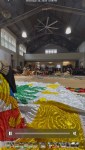
Central to the Maumau Ceremony is the role of the Fahu. Her presence is essential, and her actions carry significant weight. Gifts were given for the Fahu, including Tongan mats, ngatu (tapa cloth), blankets, and money. This act symbolizes her acceptance of their offering of humility, love, and grief.
For those who understand and value our culture and tradition, Maumau is deeply an emotional and humbling experience. It reinforces that death is disruptive and carries an emotional weight, allowing space for grief and communal acknowledgment of loss. We’re glad to carry forward this tradition and practice.
A traditional kava ceremony had also taken place, but that’ll be another post. Present at this Kava Ceremony and funeral procession were two nobles: Lords Vaha’i and Fakatulolo.
Rest in peace, Amelia! Toka ā ‘ihe nonga Moe Fiemalie ‘a e ‘Eiki!
‘Ofa lahi atu, Sela
 a journey in existence