RSS

Category Archives: Economics

Friday of the Third Week in Lent

Friday of the Third Week in Lent

3.1.24

Day 15 – God, amid this Lenten journey, we lift our hearts to you amidst the devastating fire in the Panhandle. We seek your strength to persevere in our commitments. As we take up our cross, we also carry the burden of those affected by the fire. Comfort the grieving, protect the displaced, and guide all in the face of this trial. May our lives witness your love and grace, bringing hope and restoration to those in need. Amen


Isn’t About Earthly Success

Isn’t About Earthly Success

2.29.24

This past Sunday’s message explored the message of Mark 8:31-38, reminding us that following Jesus isn’t about earthly success or comfort. The message emphasizes:

  • Living authentically: Upholding our values, even when faced with pressure or difficulty.
  • Love and service: Prioritizing the needs of others and demonstrating compassion, inspired by Jesus’ teachings.
  • Sacrifice and commitment: Embracing the core values of the gospel, even if it means sacrificing personal gain.

Following Jesus requires living our faith with courage and integrity. This includes standing up for what we believe in, acting with kindness, and embodying the message of love and hope through our actions. Just as the first disciples faced challenges, we, too, will encounter moments where unexpected circumstances test our faith.

We are reminded that faith is a journey with challenges, but through perseverance and commitment, we can make the world a brighter place, one act of compassion at a time.

Sela Finau


Tags: ,

Investing for the Kingdom: A Reflection on the Parable of the Talents

Investing for the Kingdom: A Reflection on the Parable of the Talents

Investing for the Kingdom: A Reflection on the Parable of the Talents

Exploring the Parable of the Talents in Matthew 25:14-30 (sermon from 11.19.23), Jesus, in preparing his disciples for the Kingdom of Heaven, narrates a story of a master entrusting different talents to three individuals before embarking on a long journey.

The master expects diligence and active engagement, not idle waiting. Upon his return, the two servants who received more talents had doubled their investments, but the one entrusted with a single talent returned it without any growth. This servant’s fear and tendency to compare himself to others led to inaction, resulting in disappointment from the master.

The key lesson drawn from this parable is a call to stewardship. As stewards of God’s gifts—be it talents, abilities, or resources—we are reminded not to waste what has been entrusted to us. The perspective of being stewards, not owners, encourages us to manage our lives, time, and resources wisely.

The sermon emphasized the importance of an open-handed approach to blessings. Rather than tightly holding onto resources, we are encouraged to give and invest in the kingdom. Fear and the trap of comparison were identified as hindrances to effective investment. The dangerous game of comparing ourselves to others can lead to playing it safe and missing out on opportunities to make a positive impact.

Faith involves taking risks and trusting in God. Stepping out in faith and risking it for Christ is the challenge presented to individuals and the church. The kingdom doesn’t grow if faith is kept private or if we expect the community to come to us. The parable challenges us to make something meaningful with our lives and take the necessary risks to be faithful stewards.

The conclusion posed a direct question: are we willing to risk our most valuable possessions for Christ and invest our treasured gifts for the kingdom? The call to let go and let God was extended, irrespective of the quantity of talents one possesses. The message resonated with a challenge to reflect on personal investments for the kingdom, emphasizing that the church will continue, but the question remains: how will our investments perform?

The final prayerful reflection urged a response like the first two servants in the parable, stating, “Here, God, I didn’t waste your investment. I used it wisely for your kingdom. I took the risk and placed my trust in you.”

What is your response to the call of faith, trust, and investment for the kingdom?

<><Sela Finau


Tags:

Keep Working

Keep Working

7.20.23

Jesus’ parable of the sower, seed, and soil speaks directly to our lives today. Each type of soil represents different aspects of our hearts and lives. The parable reminds us that success is not always immediate. It takes time for seeds to take root and grow. It requires nourishment, consistency, and the right environment. Some seeds may not make it no matter what we do, but others will flourish and bear fruit. The same applies to our efforts and endeavors – some may not work out due to the soil. The Gospel will fall on deaf ears, hardened hearts, and closed minds, but others will lead to something beautiful and meaningful.

As we navigate through the ups and downs of life, we can embody the resilience and determination of a farmer or gardener. Keep sowing seeds of love, kindness, and hope, even when it feels like the odds are against us. When we face challenges that seem beyond our control, remember that our season is coming, and our efforts will bear fruit in due time.

Just as the sower in the parable didn’t stop sowing despite the different outcomes and bad seasons, we, too, must not stop but continue to sow goodness in the world. But we must nourish our faith, trusting in God, and we will produce fruits of the kingdom, and it will multiply.


Tags: , , , ,

Homelessness

Homelessness

3.31.23

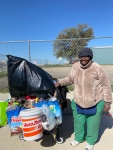
Meet my friend Mickey! We met last weekend. While on my way home from visiting a member, I noticed Mickey pushing her cart on Camp Bowie. I couldn’t pass by without offering help, for in the gospel, Jesus stopped to aid people on the road. I asked Mickey if I could pray for her, and she said yes; then, unexpectedly, she asked if she could pray for me. On a busy road in Fort Worth, I eagerly accepted.

Everything Mickey owns is captured in this picture. Mickey joined us for worship last Sunday, and we provided her with temporary housing and other essentials. However, what’s more important is that we took the time to acknowledge and greet her. Mickey is a homeless veteran who served in the Marines for seven years, but due to life’s circumstances, she’s currently living on the streets while waiting for her VA benefits. She is actively working towards getting off the streets.

Countless individuals like Mickey are homeless, and it’s essential to understand that sometimes, it’s due to circumstances beyond their control. As Christians, our duty is to provide assistance, not to judge. What if, in the coming week, we each stopped and offered help to someone and prayed for them?

This Sunday, after worship, a few of us will go out to feed our friends in the Lancaster and surrounding areas. If you’d like to contribute anything, please bring it Sunday. If you can join us, we would appreciate your help. Please let me know if you have any questions.
Pastor Sela

Thank you for allowing me to share Mickey’s story. I received permission from her to post it.


Stewardship

Stewardship

In 2008, the financial industry was hit by a major crisis highlighting the importance of sound decision-making and effective management. At the time, I was a licensed series 7 and 63 broker working in the financial securities industry while attending seminary. This experience showed me firsthand the importance of taking a long-term view and avoiding emotional attachment and personal opinions that can cloud our judgment.

Fast forward to this week, and we see Silicon Valley Bank’s and Signature Bank’s failures. At the same time, the First Republic and Credit Suisse Banks are being rescued, and still, others are on edge, which serves as a stark reminder that the health of our financial systems is closely interconnected.

As we reflect on these events, it is essential to remember the wisdom of Proverbs 27:23-24, which cautions us to be mindful of our resources and prioritize responsible stewardship. Whether we are managing our personal finances, the finances of a business or institution, or the finances of a church, it is essential to remain focused on long-term goals and avoid being swayed by short-term emotions.

In particular, managing church finances requires high accountability and transparency, as we are entrusted with the resources others have given over the years and continue to allocate toward the future. It is our responsibility to use these resources wisely and in accordance with the values and priorities of the church that will further the kingdom.

The recent bank failures also demonstrate the interconnected nature of our financial systems. As banks and financial institutions work together to manage risks and allocate resources, the failure of one institution can have ripple effects throughout the system. This is why effective regulation and oversight are essential to ensure our financial systems’ stability and resilience.

As we move forward, let us remember the past and present lessons and strive to be responsible stewards of all our personal, institutional, or pooled resources. Doing so can build a more robust and stable financial system that benefits us all in the short term and future generations.

Grace and peace!


Tags:

Love Your Neighbor

Love Your Neighbor

Day 16: Saturday, March 11, 2023

Love Your Neighbor

Scripture: You shall not take vengeance or bear a grudge against any of your people, but you shall love your neighbor as yourself: I am the Lord. (Leviticus 19:18 NRSV)

Devotion: We often hear Jesus saying to love God with all of our hearts, mind, soul, and strength and to love our neighbor. Jesus also said that loving God and neighbor were the greatest commandments of all. What we don’t often hear is that these words reiterated by Jesus also show up in the Old Testament, in the book of Leviticus:

“You shall love your neighbor as yourself: I am the Lord.” 

Who is our neighbor? Everyone. How we show love to everyone can be challenging, particularly with those whose choices we dislike, whose lifestyles we disapprove of, or anyone that’s too different. When we encounter people whose race, culture, religion, or political view differs from ours, the challenge to love them increases. God, who created and loved all people, calls and empowers us to love one another. We are called to love God with our whole selves, and we do this by loving one another and our neighbors.

C.S. Lewis once said, “Do not waste your time bothering about whether you love your neighbor; act as if you did… When you are behaving as if you love someone, you will presently come to love him.”

In this season of Lent, may we seek God’s guidance in helping us to grow our love for our neighbor.

Prayer: Holy God, you are always merciful and loving. May you continue to help us grow in our love for you through loving our neighbors. Amen

AW


Tags:

Elevator Speech on the 5 O’Clock Evening News

Elevator Speech on the 5 O’Clock Evening News

3.3.23

Dear Church,

Have you ever been caught off guard with unexpected questions about your faith and the church’s mission and ministries? Imagine being in an elevator and someone asking you why you’re a Christian, why you attend Western Hills United Methodist Church, and what your church is doing to help families in the neighborhood and address the recent crimes in the area. Do you have a prepared response? Do you have an “elevator speech”?

This happened to me recently, on Monday, but instead of an elevator, it was an impromptu interview with WFAA Channel 8. The news anchor, Scoop Jefferson, wanted to discuss the recent criminal activities in our neighborhood, including a child who was hurt over the weekend. Despite not having time to prepare, glance in the mirror, or process what was happening that I would appear on the 5:00 O’Clock evening news, I had an answer for each of the questions, although spontaneous and unpolished. (Click here for the story.) Our church’s mission field includes Las Vegas Trail (LVT), and we are committed to making a positive impact, and sharing the love of Jesus, despite the challenges. And while WFAA had a story to share, we also have a story to tell, one of Jesus and the God we serve.

It’s worth remembering that Jesus didn’t serve in a “safe neighborhood,” and those he thought would support him abandoned him. The people who shouted “Hosanna” on Palm Sunday were likely the same ones who shouted “crucify him” on Good Friday. 

As we journey through Lent, let’s prepare ourselves through prayer, self-reflection, study, and meditation. Let us not only attend worship and Sunday School but also put our faith into action. 

You are invited to join a few of us who will be taking our faith into the streets of Lancaster immediately after worship this Sunday. If you would like to contribute something, please bring it Sunday. It can be clothes, toiletries, or food items that our friends on the streets can use.

Thank you for your faithfulness.

I look forward to seeing you on Sunday!

Grace and peace,
Pastor Sela


Tags: ,

Exploitation In The South Pacific Island Kingdom Of Tonga

<brunobanani.jpg>

Exploitation In The South Pacific Island Kingdom Of Tonga

On Friday, February 7, 2014, the XXII Olympic Winter Games officially opened in Sochi, Russia, and history was made. There were 88 countries represented with a total of 2,800 athletes. Seven of those countries made their Winter Olympic debut. One of those countries and one of those athletes were from a tiny group of islands named Tonga located in Oceania, also known as the South Pacific.

In the South Pacific climate, there is no winter (at least not in the sense of “Winter Olympics”). The weather is tropical with the average temperature in Tonga at 73° F (23° C).

In Olympic President Thomas Bach’s speech at the Opening Ceremony, he asserted that the “Olympic Games are a sports festival in praising human diversity in great unity” and all people are welcome regardless of their national origin. In reality, he failed to acknowledge the role of power and money. The Olympic Games are anything but a place where human diversity is truly represented, and certainly not an actual goal.

To be part of the festival of “human diversity in great unity” one must have access to an adequate amount of money and power, either from family wealth and/or sponsorship. If diversity and unity were the Olympic Games’ goal, then it failed to recognize countries and persons unable to participate due to lack of resources or funding.

It seems that countries around the world are not represented by their human capacity at the Olympic Games, but by countries that flaunt their power and money in the elite development of their athletes, or better yet, by a display of selected human athletes from particular countries who are blessed with winter seasons and mountainous terrains.

Thus, it seems rather odd that a country from the South Pacific would even consider or blink an eye at a chance to participate and be represented at the Winter Olympic Games. But Tonga, that tiny group of islands barely visible on the world map, taking part in the Winter Olympics in Sochi was exactly what happened. It was a dream come true for the tiny island kingdom and its solo athlete in luge, a sport unheard of in the South Pacific, nonetheless Tonga.

If imperialism and colonialism are defined by acts in which a dominant culture marginalizes subgroups and exploits a minority group, then this is precisely what happened. Subjugation of the island kingdom by misuse and abuse of power and money by the hegemonic culture is what took place, an unjust practice all-too-often familiar to people of color.

While the physical presence of Tonga was clearly represented at the Olympic Winter Games, the name Bruno Banani is anything but representative of the island kingdom and its rich culture and traditions, where naming is one of its core values and beliefs. While a small percentage of Tongans hold German surnames due to their ancestral heritage, Bruno Banani is not one of them. Rather, Bruno Banani is a German men’s underwear company that made a shrill business dealing with Makai Inc., a Euro-American marketing company, in the name of global capitalism and in overt exploitation of a marginalized group’s inspiration.

Clearly, corporate responsibility and human dignity were not the goal, especially not for a young company like Makai that is zealous to make a name for itself with experiential strategies.

“The domestication of the corporation into local society serves only to further mystify the location of power, which rest not in the locality but in the global headquarters of the company which coordinates its activities. Global capitalism is not a site for liberation but manipulation. It is the site the inhabitants of which must be liberated from themselves (stripped of their identities) to be homogenized into the global culture of capital” (Arif Dirlik, “The Global in the Local”).

As the tale has been told, Makai Inc came across this mischievous golden opportunity as an experimental marketing tactic in 2008. The company had a connection with Tonga’s Princess Salote Mafile’o Pilolevu Tuita, who desired for her country to be represented at the Winter Olympics.

A search for a luger was conducted in the island kingdom. There were at least 20-30 other athletes that showed up and tried out, even when they did not understand the sport of luge. Who wouldn’t if one might be given the lifetime opportunity to represent their beloved country in the Winter Olympic Games.

The selected luger was Fuahea Semi, a 26-year-old computer science student, who played rugby as a hobby with his friends. He was chosen not only for his athletic abilities but also for his humility. Who knew that humbleness was to be part of a sport’s qualification! Perhaps it is a necessary criterion for a Western marketing firm with its white executives’ coercion and exploitation of a brown body, with less chance of any protest from the brown-skin Polynesian man.

Makai Inc explained to Fuahea Semi that luge was an expensive sport and that he would need a sponsor to cover the expenses. To attract the right sponsor, Fuahea Semi, would need to change his name. This is when Makai approached Bruno Banani, the German underwear company with their scheming creative marketing ideas.

The Tongan athlete, Fuahea Semi, who had never experienced temperature below 60° F and snow, moved to Germany in 2009 to train. Many questions were raised about this dark-skinned man’s name being Bruno Banani, and they were all given the response that it was his name, and his passport was proof.

After a year of training, Bruno Banani came within one point of qualifying for the Vancouver Olympics in 2010, but he crashed in his last attempt and ended up in the hospital.

In December 2013, Bruno Banani qualified for the Sochi Winter Olympics placing 28th out of 42 lugers, even after newspapers and websites from around the world suggested that Bruno Banani should not be allowed to compete for a spot in Sochi. Bruno Banani finished 32nd in the luge final in Sochi.

This story has made world headlines. Even Thomas Bach, the president of the International Olympics Committee, called it “a perverse marketing idea….done in bad taste to change your name to that of a sponsor. This has nothing to do with proper marketing.” Yet, since Bruno Banani qualified for the Sochi games, the Olympics Committee could not prevent him from competing. After all, his name was legally changed on his passport.

Even though Bruno Banani was the name that made history for the individual and the island kingdom’s debut in the Winter Olympics Games, the whole thing was ludicrous and disconcerting. As Frantz Fanon wrote in Wretched of the Earth, “The colonist also makes history and knows it. The history he writes is therefore not the history of the country he is despoiling, but the history of his own nations’ [exploitations, racism, and injustice].”

Tu’a ‘Ofa Atu, Sela E. Finau. s.finau@yahoo.com. Follow her blog @ https://finaus.wordpress.com/.

Image


Tags: , , , , , ,

Here in the U.S. and around the world!

As we, here in the U.S., are smothered over with record blizzards and ice storms, the Dow seems to be doing just fine. I think. It just closed at its highest level in 2 1/2 years. On the commodities, forex, and futures side, well, you’ll just have to check it out. What does this mean? I’ll let you be the futurist, analyst, and economist on this.

Around the world is a country in turmoil, Egypt. Over on the Pacific side is a monster cyclone that is causing severe damage in parts of Australia. I have heaps of family over that way, but I don’t think they’re in the areas that are mostly affected. Still, I hope that everyone is okay, here locally and around the globe. After all, all of humanity is a multiplicity of earth creatures’ family! Do pray for us all.

 
Leave a comment

Posted by on February 2, 2011 in Economics, Life